

A false confession involves an admission of guilt that is factually untrue. A false confession is used by the prosecution to provide evidence about the guilt of a defendant in a criminal case. People falsely confess for reasons such as police coercion, psychological pressure, and implied leniency offered by interrogators. These types of interrogation tactics lead to forced confessions, not voluntary, knowing, and truthful admissions of guilt. The risk increases when the suspect is young, mentally vulnerable, inexperienced with the criminal justice system, or physically exhausted. False confession statistics indicate that up to 29% of DNA exonerations involved false or coerced confessions. There are a number of well-known false confession cases such as the Thomas Jesse Ward and Karl Allen Fontenot case that took place in Ada, Oklahoma.
What is a False Confession?
A false confession is defined an admission of guilt that is factually untrue and is obtained during a police interrogation, A false confession is offered by the prosecution as evidence of guilt. False confessions are categorized into compliant and internalized. Compliant confessions are coerced by police by using isolation, psychological pressure, or prolonged questioning. These tactics create duress in the detainee, causing them to confess in order to escape the pressure of the interrogation. Internalized confessions means the suspect comes to believe the false narrative due to repeated accusations and misleading information that is supplied by investigators during interrogation. The interrogation commonly occurs in a custodial and controlled environment where the suspect is isolated from family, counsel, and outside support. Psychological pressure is applied by police through repetitive questioning, asserted certainty of guilt, and authority driven confrontation. Misleading tactics are used by interrogators such as presenting false evidence, exaggerating proof, or minimizing the seriousness of the offense. Other tactics include using implied leniency to suggest that cooperation or confession by the detainee will lead to a better outcome. This is done without an explicit promise of leniency. These combined factors can undermine voluntariness and reliability, making a false confession legally vulnerable to suppression and a significant risk factor for wrongful conviction.
Why Do People Falsely Confess?
People falsely confess because interrogation tactics and personal vulnerabilities combine to overwhelm their resistance and distort their decision making ability. People falsely confess under the pressure of prolonged questioning by law enforcement. This prolonged isolation creates the illusion isolation that law enforcement officers are the only perceived source of relief. Interrogators use psychological pressure such as repetitive accusations, asserted certainty of guilt, and control of time, movement, and environment to get false confessions from detainees. Some people falsely confess in a compliant manner to escape stress, fatigue, fear, or perceived threats. This occurs even when the detainee knows the confession is false. Other people falsely confess in an internalized manner. This happens because misleading tactics such as false evidence claims or minimization cause them to doubt their own memory. A detainee that doubts their own memory more easily accepts the narrative given by investigators. The risk increases for juveniles, mentally vulnerable individuals, or suspects unfamiliar with police procedures, especially when implied leniency suggests that confession will lead to a better outcome without an explicit promise.
The reasons people falsely confess to crimes the did not commit are listed below.
- duress
- coercion
- intoxication
- diminished capacity
- mental impairment
- ignorance of the law
- fear of violence
- the actual infliction of harm
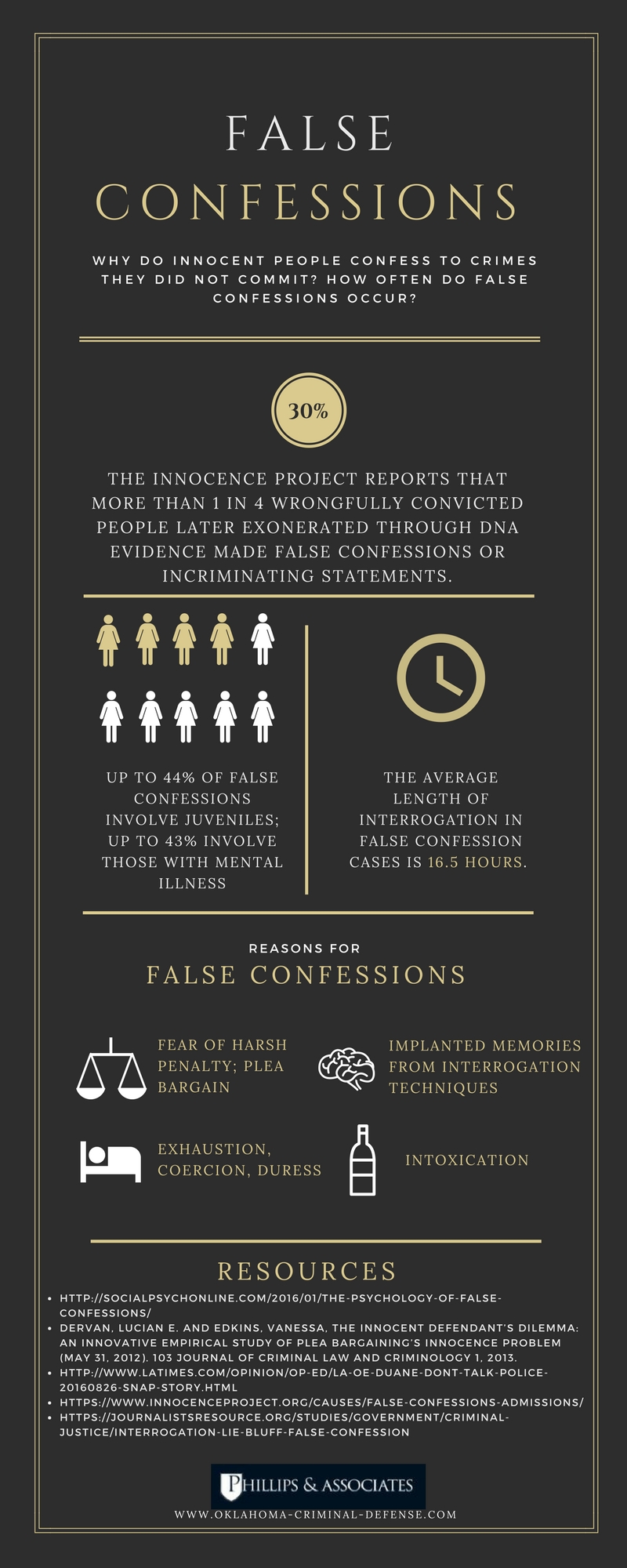
- the threat of a harsh sentence
- misunderstanding the situation
False Confession Statistics
False confession statistics in the United States show that false admissions play a major role in wrongful convictions. This is most noticeable in DNA exoneration cases and juvenile prosecutions. In the United States, data from multiple innocence focused studies demonstrate consistent numeric patterns related to false confessions.
29 percent of DNA exoneration cases involved false confessions. One Innocence Project review of 375 DNA exonerees showed that 29 percent included a false confession or incriminating statement by the defendant. An earlier Innocence Project review reported a similar result. They found that 25 percent of exonerees had confessed, made self-incriminating statements, or entered guilty pleas despite the fact that they were innocent.
Youth are disproportionately represented in false confession cases. Forty-nine percent of individuals exonerated through DNA evidence who falsely confessed were 21 years old or younger at the time of arrest, and 31 percent were 18 years old or younger. A separate study found false confessions in 38 percent of juvenile exonerations compared to only 11 percent of adult exonerations.
National exoneration data confirms the pattern across all crimes. According to the National Registry of Exonerations, roughly 13 percent of all 3,608 recorded exonerations involved false confessions. The percentage increases significantly when focusing on serious offenses.
Murder cases show the highest concentration of false confessions. Among 137 DNA exonerees wrongfully convicted of murder, 61 percent had false confession involvement. Within those cases, 33 involved the exoneree confessing personally, 20 involved a co defendant confession, and 30 involved both. At least 52 percent of these murder related false confessions contained non public crime facts, indicating that investigators likely supplied details during interrogation. In 22 percent of false confession cases, exculpatory DNA evidence existed at trial but was ignored.
Interrogation length and demographics further contextualize the statistics. Research summaries show that individuals who later were determined to have falsely confessed were often interrogated for up to 16 hours on average. Across DNA exoneration cases overall, approximately 60 percent of exonerees were African American, 31 percent were Caucasian, and 8 percent were Latinx, highlighting racial overrepresentation in wrongful conviction cases that also involve confession errors.
Overall, false confessions appear in roughly 13 to 29 percent of exonerations depending on the dataset, exceed 60 percent in murder exonerations, and affect juveniles at rates more than three times higher than adults.
False Confession Cases
One of the most famous false confession cases in Oklahoma is that of Thomas Jesse Ward and Karl Allen Fontenot. Ward and Fontenot were both arrested in connection with the 1984 disappearance and murder of Donna Haraway after giving so-called “dream confessions” to investigators in Ada, Oklahoma. In those interrogations, each man described having dreams about committing the crime, even though there was no physical evidence tying them to the murder. The men's accounts contained conflicting and implausible details about the murder. District Attorney William N. Peterson and his top assistant Christopher L. Ross, pressed charges and secured convictions against Thomas Jesse Ward and Karl Allen Fontenot based largely on their interrogations. A Oklahoma jury convicted Ward and Fontenot and sentenced both to death based largely on those "dream" statements and very little other testimony. The death penalty was awarded despite the lack of corroborating evidence and later contradictions with the actual evidence, such as Haraway’s body being located miles from the original scene.
Share this Image On Your Site
<p><strong>Used with Permission - Courtesy the Phillips and Associates.</strong><br><br><a href="http://www.oklahoma-criminal-defense.com"><img src="https://cdn.prod.website-files.com/5d8674df08e53e517fe73292/5e3b203a1325272db43be020_False%20confessions.jpg" alt="Infographic: False Confessions" width="540px" border="0"></a></p>
